
CS603 Assignment 2 Solution 2026
CS603 Assignment 2 Solution 2026.
CS603 Assignment 2 Solution 2026. Mastering the concepts of Software Architecture and Design is essential for every computer science student at Virtual University. As we delve into the Spring 2026 semester, the CS603 assignment has become a benchmark for understanding the Model-View-Controller (MVC) architectural pattern. If you are seeking professional guidance, remember that Vu all Free services available 03402118621 is here to support your academic journey.
Understanding the MVC Architectural Pattern
The Model-View-Controller (MVC) pattern is the backbone of modern web application development. It separates an application into three interconnected components to manage complex logic efficiently.
- The Model: This represents the data and the business logic of the application.
- The View: This is the visual interface that the user interacts with.
- The Controller: This acts as an intermediary that processes user input and updates the Model or View accordingly.
For students struggling to grasp these concepts, platforms like exammasterai.com offer specialized resources to simplify these complex architectural patterns.
Assignment 2 Solution: Step-by-Step Breakdown
Question A: Sequence Diagram for Concert Ticket Order
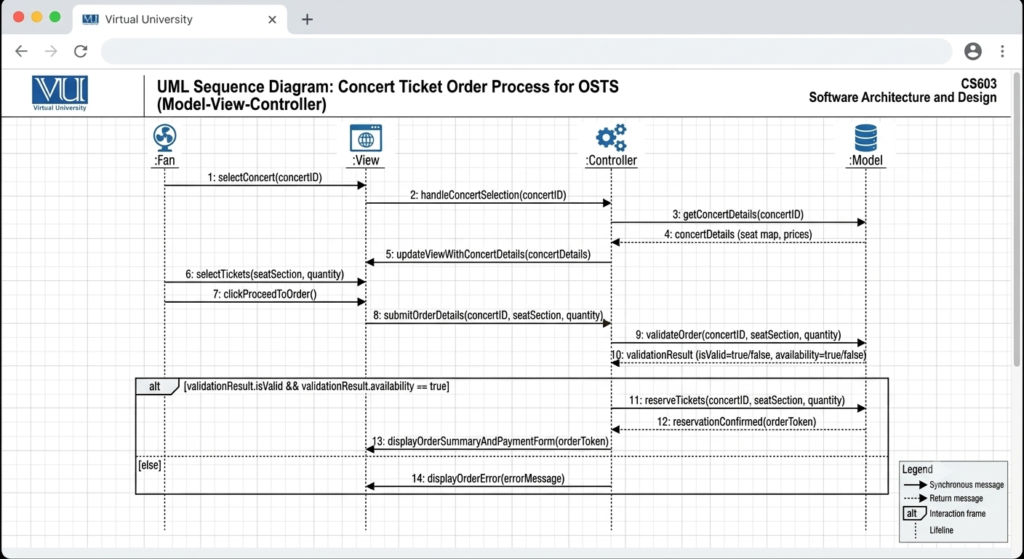
A sequence diagram is a powerful UML tool used to depict the flow of interactions in a system. When a fan initiates a concert ticket order in the Online Stadium Ticketing System (OSTS), the interaction occurs as follows:
- Initiation: The Fan interacts with the View, selecting an event.
- Request Handling: The View sends the event ID to the Controller.
- Data Validation: The Controller queries the Model to check for seat availability.
- Confirmation: The Model validates the request and returns the status, allowing the Controller to update the View with a confirmation message.
Need help visualizing these diagrams? Contact Vu all Free services available 03402118621 for expert drafting.
Question B: Reducing Interdependencies
In software design, reducing interdependencies—or “coupling”—is crucial for maintaining system modularity. The principle that achieves this is the Dependency Inversion Principle. By relying on abstractions, components like the Controller and Model can function independently, ensuring that changes in one do not destabilize the entire system.
Question C: Executing Business Logic
The Model is the primary component responsible for executing business logic and validating transaction requests. It ensures that every action—such as checking seat availability or processing payment—adheres to the strict business rules defined for the stadium ticketing system.
Question D: The Role of the Controller
A common mistake students make is allowing the Controller to update the user interface (UI) directly. According to architectural best practices, the Controller should not directly manipulate the View. Instead, the Controller should modify the Model, and the View should automatically reflect those changes. This ensures a clean “Separation of Concerns,” which is vital for high-quality software design.
Boost Your Academic Success with Exam Master AI
At exammasterai.com, we are dedicated to helping international and local students succeed. Whether you are looking for past papers from Waqar Sidhu or Junaid files, our portal provides the resources you need to excel in your studies.
Why Choose Our Services?
- Accurate Solutions: We provide 100% accurate solutions designed to help you secure 20/20 marks.
- Expert Support: Our team, accessible via 0340-2119621, is always ready to help you navigate your assignments.
- Community Focused: Join our “VIRTUAL ALERT’S OFFICIAL” community on WhatsApp for real-time exam reviews and tips.
Conclusion
Success in CS603 requires both theoretical knowledge and practical application. By understanding the MVC pattern and implementing architectural principles like Dependency Inversion, you can build robust systems. Remember that your hard work, combined with the right resources from exammasterai.com, will pave your way to success in the Spring 2026 semester.

1 Comment