



What is Active Learning? The Ultimate Guide to Modern Smart Study Techniques
Discover how active learning, computer-based testing, and interactive tools can transform your study routine, improve exam grades, and boost memory retention.
The way we acquire knowledge is changing faster than ever before. Traditional rote learning—where students simply memorize textbooks line by line—is no longer enough to succeed in modern examinations. Today, the focus has shifted toward true Learning, which emphasizes deep conceptual understanding, critical thinking, and the practical application of knowledge.
Whether you are a Class 9 student preparing for board exams, a teacher designing daily quizzes, or an independent learner mastering a new skill, understanding how your brain processes information is the key to academic success. This comprehensive guide explores the science of learning, effective study methodologies, and how digital platforms are making smart education accessible to everyone.
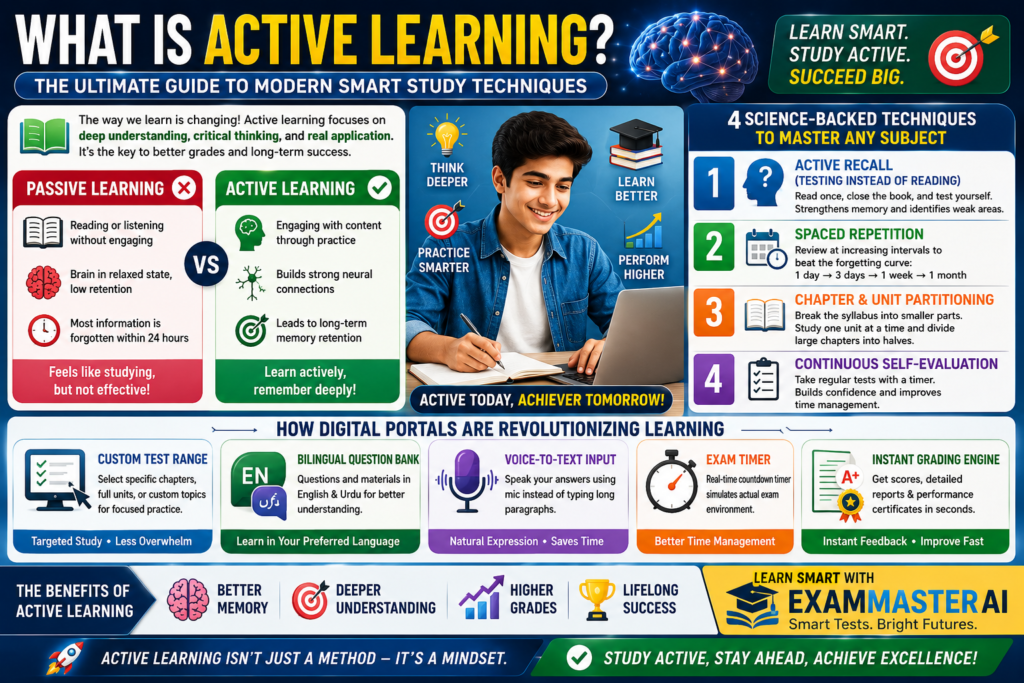
Passive Learning vs. Active Learning
To optimize your study habits, you must first understand the difference between passive and active learning models.
- Passive Learning: This happens when you simply read a book, highlight text, or listen to a lecture without interacting with the material. While it feels like you are studying, your brain is in a relaxed state, meaning most of the information will be forgotten within 24 hours.
- Active Learning: This occurs when you actively engage your brain with the content. It involves testing yourself, summarizing chapters in your own words, solving practice questions, and correcting your mistakes. Active learning forces your brain to build strong neural connections, leading to long-term memory retention.
4 Science-Backed Techniques to Master Any Subject
1. Active Recall (Testing Instead of Reading)
Instead of reading a chapter over and over again, read it once and then immediately close the book. Force your brain to recall what you just read by answering specific questions or taking an online quiz. This practice strengthens your memory and highlights exactly what topics you need to review.
2. Spaced Repetition
Our brains naturally forget information over time (a concept known as the Forgetting Curve). To combat this, you should review your syllabus at increasing intervals—for example, review a topic 1 day after learning it, then 3 days later, then a week later, and finally a month later.
3. Chapter and Unit Partitioning
Trying to learn an entire textbook in one night leads to cognitive overload and stress. The smartest way to learn is by breaking the curriculum down into smaller, manageable pieces.
- Focus on one unit or chapter at a time.
- Divide large chapters into a First Half and a Second Half to master core concepts before moving forward.
4. Continuous Self-Evaluation
You cannot improve what you do not measure. Regularly testing yourself under exam conditions—complete with an exam countdown timer—builds your confidence and trains you to manage your time effectively during real board examinations.
How Digital Portals are Revolutionizing the Learning Process
Modern e-learning ecosystems like Exammasterai are designed around these active learning principles, providing tools that make studying interactive, fast, and highly efficient:
| Learning Feature | Technical Function | Educational Benefit |
| Custom Test Range | Allows students to select specific chapters, full units, or custom topic ranges for custom practice. | Prevents overwhelm and enables targeted, micro-level studying. |
| Bilingual Question Bank | Displays exam questions and learning materials in structured formats. | Helps students understand complex technical terms in their preferred language medium. |
| Voice-to-Text Input | Allows students to speak their answers using a microphone icon instead of typing long paragraphs. | Encourages natural verbal expression and speeds up subjective test preparation. |
| Instant Grading Engine | Generates detailed evaluation scores and official Performance Certificates in seconds. | Provides immediate feedback so learners can instantly correct their mistakes. |
Conclusion
True learning is an active journey, not a passive chore. By shifting your study habits away from mindless reading and moving toward active recall, targeted unit practice, and instant digital self-evaluation, you can unlock your full academic potential. Embrace these smart study techniques today, leverage modern educational tools, and watch your grades and conceptual understanding reach new heights!
Focus Tags for this Post (Single Paragraph)
learning techniques, active learning guide, smart study habits, active recall education, spaced repetition method, exammasterai, how to study for exams, student learning tips, digital education tools, chapter wise test practice, improving exam grades, memory retention techniques, computer based learning, student self evaluation, online study portal
Tag:active learning guide, active recall education, chapter wise test practice, computer based learning, digital education tools, exammasterai, how to study for exams, improving exam grades, learning techniques, memory retention techniques, online study portal, smart study habits, spaced repetition method, student learning tips, student self evaluation