

The Art of Active Reading: How to Comprehend and Retain Dense Textbook Chapters
Master the skill of active reading. Learn scientific strategies to extract MCQs, short questions, and key concepts from textbooks for maximum exam retention.
Introduction
We spend thousands of hours reading throughout our academic lives, yet many students find themselves finishing a textbook chapter only to realize they can’t remember a single line they just read. Mindless reading—where your eyes scan the text while your brain wanders elsewhere—is one of the biggest hidden causes of exam stress.
True Reading is not a passive chore; it is an active skill. Whether you are analyzing a complex Physics chapter, studying intricate Computer Science concepts, or preparing for board exams, learning how to read with purpose is the fastest way to boost your grades. This comprehensive guide covers the science of active reading, systematic chapter breakdown techniques, and how digital tools turn reading into long-term knowledge.
The Problem with Passive Reading (Why We Forget)
When students read a textbook like a storybook, they are engaging in passive reading. This method tricks the brain into feeling a sense of familiarity, making you believe you understand the material. However, because the brain isn’t forced to process or reorganize the information, it quickly filters it out as “temporary data.”
To transition from passive scanning to deep cognitive retention, you must implement a structured reading strategy that actively challenges your brain to extract value from every page.
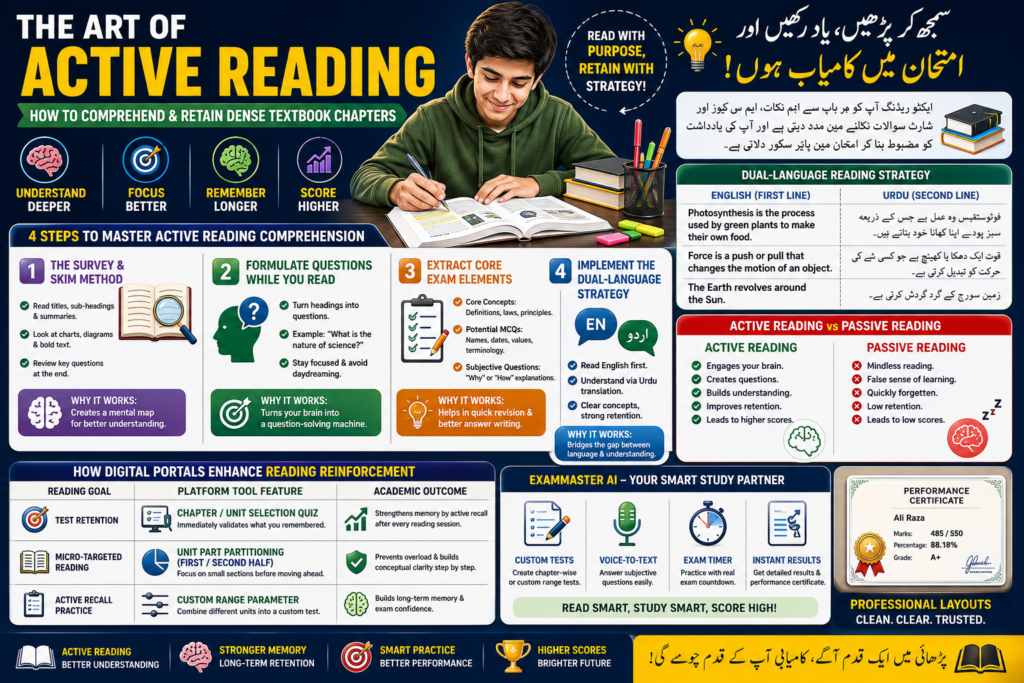
4 Steps to Master Active Reading Comprehension
1. The Survey and Skim Method
Before diving into the first paragraph of a new chapter, spend 5 minutes surveying the entire layout.
- Read the main titles and sub-headings.
- Look closely at charts, bold text, and diagrams.
- Review the summary or key questions at the end of the chapter.
- Why this works: This brief overview creates a mental filing cabinet in your brain, making it much easier to categorize information when you start reading in detail.
2. Formulate Questions While You Read
Never read aimlessly. Turn sub-headings into active questions. For instance, if a sub-heading in a Class 9 science book says “The Nature of Science,” transform it in your mind to: “What exactly is the nature of science, and what are its key branches?” Reading with the specific goal of answering a question keeps your mind highly focused and prevents daydreaming.
3. Extract Core Exam Elements
As you go through your textbook sections, actively train your eyes to identify and extract three core types of information:
- Core Concepts: High-level definitions and laws that form the backbone of the subject.
- Potential MCQs: Important dates, names, numerical values, and specific terminology that can easily be turned into multiple-choice questions.
- Subjective Questions: Identifying sentences that explain the “Why” or “How” of a process, which are perfect candidates for short and long-form exam questions.
4. Implement the Dual-Language Strategy
For students navigating bilingual education systems (such as the Punjab Textbook Board or Virtual University models), reading efficiency can be drastically improved by utilizing structured bilingual content layout alignment. Reading the technical definition in English on the first line, followed immediately by its Urdu translation directly below it, helps clear up conceptual confusion instantly, bridging the gap between language comprehension and technical mastery.
How Digital Portals Enhance Reading Reinforcement
Reading is only the first step; testing your reading retention is where the real mastery happens. Digital assessment systems like Exammasterai are built to perfectly complement your textbook reading routine:
| Reading Goal | Platform Tool Feature | Academic Outcome |
| Test Retention | Chapter/Unit Selection Quiz | Immediately validates what you remembered from your reading session. |
| Micro-Targeted Reading | Unit Part Partitioning (First/Second Half) | Allows you to read and test on a small, specific section before moving to the next. |
| Active Recall Practice | Custom Range Parameter | Combines different read units into a single custom exam to build long-term memory. |
Conclusion
Great students aren’t necessarily those who spend the most hours reading; they are the ones who know how to read strategically. By surveying chapters beforehand, turning headings into active questions, extracting potential questions, and reinforcing your reading sessions with targeted digital quizzes, you turn a passive textbook into a powerful tool for success. Open your books with purpose, change the way you read, and watch your understanding reach a whole new level!
Focus Tags for this Post (Single Paragraph)
active reading strategies, textbook comprehension tips, how to read to learn, exammasterai, improving study retention, skimming and scanning method, extracting textbook mcqs, student reading skills, bilingual learning layout, chapter wise comprehension, board exam preparation, active recall reading, smart study techniques, improving reading focus, digital test reinforcement
Tag:active reading strategies, active recall reading, bilingual learning layout, board exam preparation, chapter wise comprehension, digital test reinforcement, exammasterai, extracting textbook mcqs, how to read to learn, improving reading focus, improving study retention, skimming and scanning method, smart study techniques, student reading skills, textbook comprehension tips